


How Our 3D Scanning Jewelry Wax Setting Machine Solved the Headaches of Traditional Diamond Setting – A Real Case from Shenzhen of China
Yesterday, Mr. Wang from Shenzhen ,China gave us a call to inquire about our 3D Scanning Jewelry Wax Stone Setting Machine. He's currently using a conventional teachbox diamond stone setting machine, which has become a serious pain point. Despite spending hours programming, the machine misaligns stone positions within just 30 minutes of operation. His workers constantly tweak the machine, frustrated to the point of burnout. He told us, “We’d rather set stones by hand than rely on this unstable system.”
With peak season in full swing, he’s overwhelmed. Skilled stone setters are hard to find, and outsourcing is risky—everyone says they’re too busy, and quality is never guaranteed. He wanted to know: can our 3D scanning automatic diamond stone setting machine solve this problem?
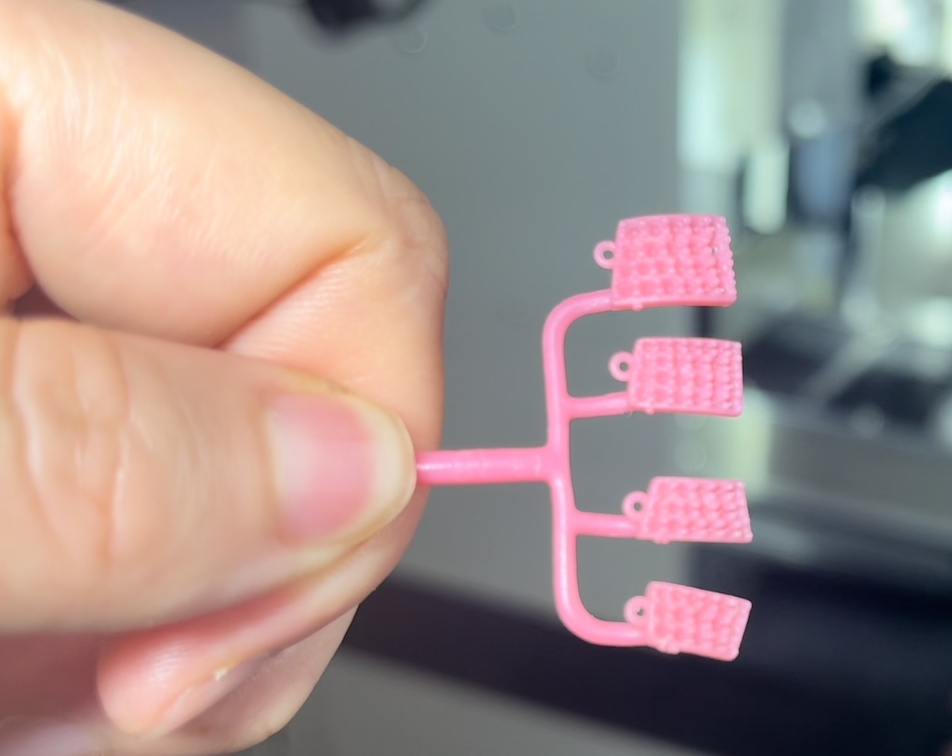
We arranged a demo for the next day. Mr. Wang arrived with wax molds made of red wax. Each wax column held four different pendant-style molds, ranging from large to extra small. The largest was about the size of a fingernail; the smallest was two-thirds smaller. The large mold contained 21 stones of 3 sizes: one 2mm, three 1.5mm, and seventeen 1.25mm. The medium mold used 1.75mm, 1.25mm, and 1.0mm stones. The small mold featured 1.5mm, 1.0mm, and 0.9mm stones. The extra small mold had 1.25mm, 0.9mm, and even 0.8mm stones.
Mr. Wang explained that his client orders 10,000 units per month. His team works overtime until 10 p.m. and starts again at 8 a.m., with just two days off each month. Traditional stone setting machines produce inconsistent results, with frequent misalignments. “My technicians are exhausted,” he said. “They’re constantly tuning machines. Some are ready to cry.”
I examined the finished molds under a microscope—his quality standards are extremely high. Not a single stone can be even slightly tilted. The products are destined for a European luxury jewelry brand, where precision is non-negotiable.
I explained why most stone setting robots on the market fall short. Their programming relies on manual position-based inputs, controlled by a joystick to move the X and Z axes, with 5-dimensional A/C rotational controls. For most operators, it’s extremely difficult to understand three-dimensional space—let alone five. It’s not just confusing—it’s impractical. Accuracy is judged by the naked eye, which can at best achieve 0.1mm precision. These systems still rely heavily on experienced technicians who need 6+ months of training just to write functional programs.
Worse still, the position-based system allows for low structural precision. Whether the X, Y, and Z axes are perpendicular, or whether the suction nozzle is slightly crooked—none of it matters to the traditional system, as long as the nozzle appears visually aligned with the mold. This flawed assumption makes manufacturers believe high mechanical precision is unnecessary. They fail to account for the root causes of tilted stones: mechanical misalignment and the inability to precisely reset A/C rotation angles.
Stone setting may look small, but it demands high precision. What sets our machine apart is that it’s built from the ground up with usability and performance in mind—a rare combination in the industry.
And we proved it. In under 20 minutes, our technician completed all of Mr. Wang’s molds. Under the microscope, every stone was perfectly placed—flat, straight, and accurate. He was amazed.
“You’ve built something incredible,” he said. “Your scanner turns the mold into a 3D model, and with just a click on each stone seat, the machine generates the full stone layout. All I had to do was hit ‘Start’—no extra alignment needed. The programming speed and setting precision are next level.”

He took the samples back to his QA team for testing and mold casting. We’ll hear back in a couple of days.
If you're frustrated with the limitations of traditional diamond stone setting machines, we welcome you to send us your samples or visit for a test. Our 3D Scanning Jewelry Wax Stone Setting Machine could be your entry into a new era of automation and reliability.